
Why “I Feel Like” Is Not Actually a Feeling
Learning to identify feelings is often like learning a new language.

Many couples believe they are expressing emotions when they are actually expressing thoughts, interpretations, or conclusions about the other person’s behavior. This may seem like a small distinction, but it often changes the entire tone of a difficult conversation.
For example, there is a difference between saying:
“I feel like you do not care about me”
and
“I feel hurt and alone.”
The first statement usually sounds like criticism to the listening partner, even if that was not the intention. The second gives insight into what is happening emotionally inside the person speaking. Many couples begin practicing this kind of emotional clarity through the Renew process, where they learn how to express feelings in ways that create connection instead of defensiveness.
One simple way to tell the difference is this:
If you can substitute the words “I think” for “I feel,” you are probably expressing a thought rather than an emotion.
For example:
“I feel like you never listen to me”
could become:
“I think you never listen to me.”
That shift matters because thoughts often invite debate, defensiveness, and counterarguments, while feelings tend to create emotional understanding and connection.
Most couples are not arguing only about dishes, schedules, intimacy, tone of voice, or text messages. Underneath those surface conflicts are usually deeper emotional experiences:
feeling rejected,
unimportant,
alone,
overwhelmed,
unseen,
or disconnected.
The problem is that many people were never taught how to identify or express those emotions clearly.
Instead, people often learn to:
explain,
justify,
criticize,
withdraw,
over function,
shut down,
or become defensive.
Over time, couples can become so focused on proving their point that they lose contact with the emotional experience underneath the argument itself.
This is one reason difficult conversations can escalate so quickly. When people do not feel emotionally understood, they often begin fighting harder to explain themselves. Meanwhile, the listening partner may feel blamed, criticized, or attacked and become defensive in return.
Both people are usually trying to protect themselves while simultaneously longing to feel understood by each other. For couples who feel stuck in these repeating communication patterns, a relationship intensive can offer the focused structure needed to shift the dynamic more quickly.
In my work with couples, I often encourage people to slow conversations down and become more curious about what is happening underneath the words. Sometimes this means moving beyond “What happened?” and asking:
“What am I actually feeling right now?”
At first, this can feel surprisingly difficult.
Many people can quickly identify thoughts:
“I think you are angry.”
“I think you do not respect me.”
“I think nothing I do is enough.”
But identifying the underlying feeling often takes more time and self-awareness.
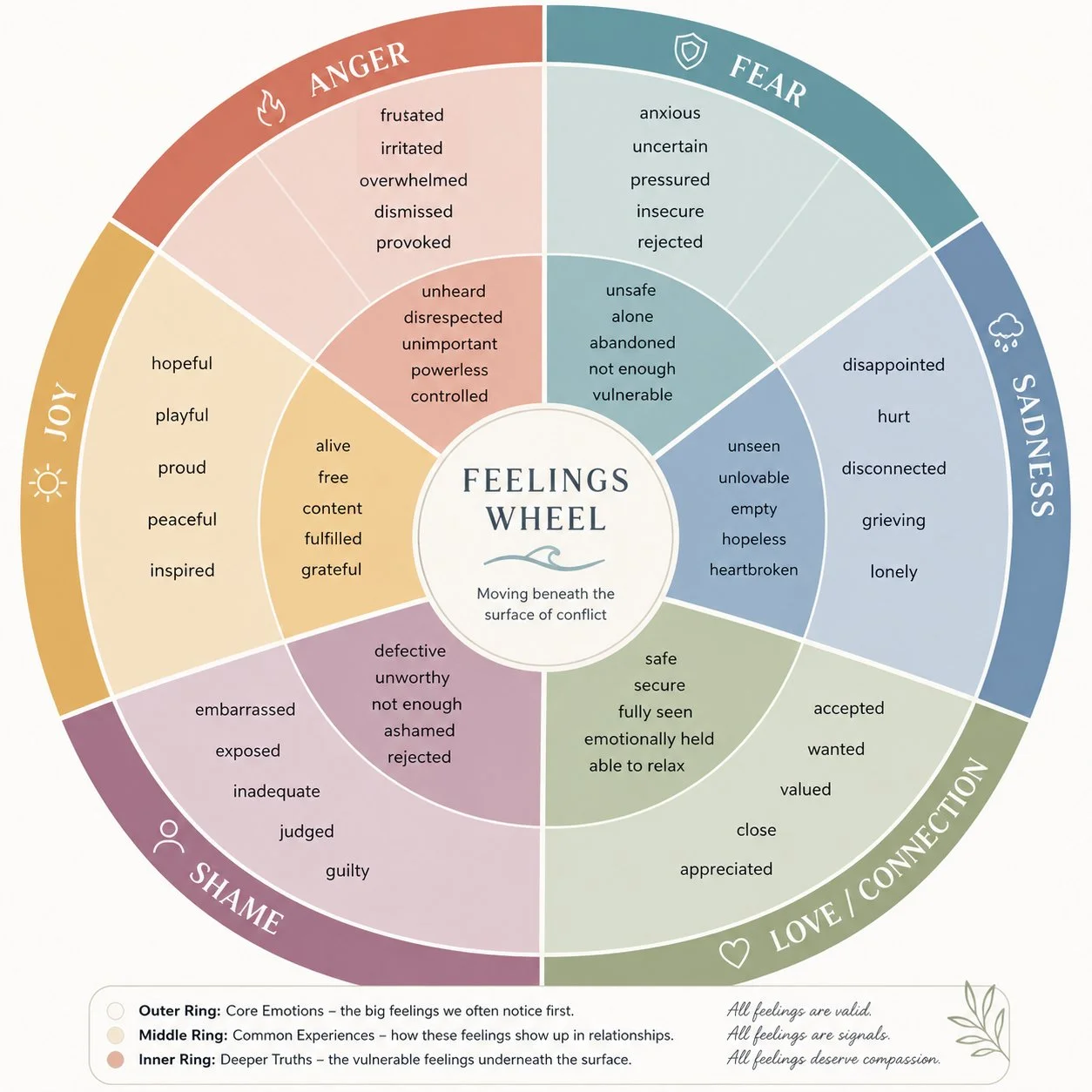
This is where a feelings wheel can sometimes help.
Rather than asking, 'What is wrong with me?' or 'What is wrong with my partner?', the wheel invites us to ask a different question: 'What am I actually experiencing right now?'
Many people grew up with a very limited emotional vocabulary. They learned emotions like angry, stressed, fine, frustrated, or upset, but had little language for more vulnerable experiences like disappointment, loneliness, grief, embarrassment, fear, rejection, or shame.
One thing that makes this feelings wheel a little different is that it is designed to be explored from the outside in. The outer ring contains the emotions we tend to notice first. As you move toward the center, the feelings often become more personal, vulnerable, and emotionally revealing.
For example, someone might initially notice feeling angry, then recognize feeling dismissed, and eventually realize they feel unheard or unimportant underneath the frustration. The goal is not to find the "right" feeling. It is to become more curious about what may be happening beneath the surface of the conflict.
A feelings wheel can help slow conversations down enough for people to better recognize and communicate what is happening internally before the conversation turns into defensiveness or emotional shutdown.
Interestingly, many couples discover that underneath anger is often something much softer and more vulnerable.
Sometimes it is:
“I miss you.”
“I do not feel important to you.”
“I feel alone in this.”
“I was hurt more than I expected.”
“I am afraid we are drifting apart.”
Those conversations tend to create a very different emotional response than criticism or blame.
This does not mean couples should never talk about behaviors, boundaries, responsibilities, or conflict. Those conversations matter too. But relationships often begin shifting when both people become more capable of expressing the emotional experience underneath the argument instead of only reacting to the surface conflict itself.
Healthy communication is not about saying everything perfectly. It is about learning how to stay emotionally connected while discussing difficult things.
If you’re already in a long‑term relationship, the Renew process can help you strengthen emotional communication and reduce defensiveness. If you’re preparing for marriage, Engage offers a way to build these skills early so they become part of your foundation.
This is the kind of work I often help couples practice in therapy. Slowing conversations down, understanding the patterns underneath the conflict, and helping both partners feel more seen, heard, and emotionally understood.
About the Author
Kathryn "Kassie" Welch is a Resident in Marriage and Family Therapy providing online therapy to couples and individuals throughout Virginia and Florida. Her work is grounded in the Gottman Method, with additional training in trauma, betrayal recovery, and neurodivergent relationships. She helps couples move beyond repeating patterns, strengthen communication, and create relationships that become a source of support rather than another source of stress.
Learn more or schedule a consultation at EngageRenewTherapy.com.

Continue Reading…
Taking space during conflict can help, but only if couples also know how to come back together afterward.

By the time a couple is arguing, defending themselves, shutting down, or trying to prove a point, they have usually missed several warning signs along the way.

Many couples come to therapy believing the goal is to solve their disagreements once and for all. If they can just communicate better, explain themselves more clearly, or finally get their partner to see things their way, the conflict will disappear.
Unfortunately, relationships do not work that way.