
Are You Running Your Emotions, or Are Your Emotions Running You?
The Control Freak, the Escape Artist, and the part of you that learns to navigate

One of the things I say all the time in therapy is, "You want to have your emotions, not have your emotions have you." Usually, I am also waving my arms around like a marionette on strings when I say it.
Because honestly, that is what emotional dysregulation can feel like. One minute you are grounded and reasonable, and the next minute some internal part grabs the strings and starts running the show. You snap at your partner, procrastinate for the fifth hour in a row, eat an entire bag of chips, doom-scroll into the wee hours, or make grand plans to completely turn your life around starting tomorrow. Then another part of you wakes up the next morning and wants to know what on earth you were thinking.
Parts-based approaches to therapy, including Internal Family Systems (IFS), recognize that we can have different internal voices pulling us in different directions. I find it helpful to give some of those voices names because it makes something complicated a little easier to recognize. The names themselves aren't particularly important, and this isn't meant to be a new psychological theory. For our purposes, let's call three of those internal positions the Control Freak, the Escape Artist, and the Navigator.
I am intentionally giving two of these parts somewhat exaggerated names. The Control Freak and the Escape Artist describe what these parts can look like when they take over, not everything they are or everything they bring to us.
Meet the Control Freak
The Control Freak believes safety comes through control. This is the part that values discipline, productivity, rules, achievement, and getting things right. It may tell you to work harder, stop making excuses, get your act together, or do something perfectly because anything less simply is not good enough.
The problem is that the Control Freak doesn't always know when to change course. It may keep working when your body is telling you to stop, keep pursuing a goal after the cost outweighs the benefit, or keep pressing your partner to resolve something when they're already flooded. It can enforce a standard even when that standard is hurting you or your relationship. Instead of adjusting the plan to fit reality, the Control Freak keeps trying to make reality fit the plan.
The Control Freak is not necessarily the enemy. In fact, it often developed for a very good reason. Maybe mistakes were not safe growing up. Maybe emotions were not welcomed. Maybe being competent, useful, agreeable, or successful helped you feel secure. It may have helped you accomplish extraordinary things. The Control Freak can bring standards, responsibility, motivation, and follow-through. It just doesn't always know when enough is enough. Eventually, living under that much internal pressure gets exhausting. That is usually when the Escape Artist shows up.
Meet the Escape Artist
The Escape Artist has had enough. This is the part that says, "I am tired," "I deserve this," "Forget it," or perhaps most importantly, "Can we please not do hard things for five minutes?" It wants relief, pleasure, comfort, spontaneity, and escape. It may procrastinate, avoid, spend impulsively, eat something comforting, binge-watch television, or decide that whatever the Control Freak has been yelling about can become tomorrow's problem.
The Escape Artist is not the enemy either. Sometimes it is carrying something the Control Freak has forgotten entirely: we need rest, pleasure, play, creativity, and room to breathe. The problem is that the Escape Artist doesn't always know when it's time to come back. A needed break can become avoidance. Rest can become disengagement. Spending can provide a moment of relief while creating a problem for Future You. Escaping discomfort can feel wonderful in the moment while costing you something you genuinely care about.
And that's how we can start bouncing between the two. We overfunction until we collapse. We impose rigid rules until we rebel against them. We demand perfection, become overwhelmed, give up, and then invite the Control Freak back in to shame us for giving up. It is a truly terrible internal management team.
There Is Another Way
Interestingly, I think this resembles something we already understand about parenting styles. Authoritarian parenting emphasizes control and obedience, often at the expense of warmth. Permissive parenting offers warmth and freedom but too little structure. Authoritative parenting combines both: warmth and boundaries, compassion and expectations. Many of us know intellectually that children tend to do better with that balance. Yet we do not necessarily know how to offer the same thing to ourselves.
That is where the third part comes in. I call this part the Navigator. The Navigator does not silence the Control Freak or tell the Escape Artist to get lost. It listens to both without handing either one the wheel. The Control Freak might be right that something needs to get done. The Escape Artist might be right that you are exhausted. Each may be carrying useful information. That does not mean either one should be driving.
The Navigator asks a different question: "What choice is consistent with the person I want to be?" It knows where you are trying to go without insisting there is only one route to get there. It can change course when the road changes. Sometimes it follows the plan. Sometimes it recognizes that the plan is no longer working. The destination is guided by your values; the route can be flexible.
That is a very different question from "What should I do?" or "What do I feel like doing?" The Navigator takes in the information, considers both immediate needs and longer-term consequences, and decides what to do next.
The Goal Is Flexibility, Not Perfection
The Navigator is not emotionless. It still gets angry, scared, overwhelmed, disappointed, jealous, tired, and hurt. Emotional regulation does not mean eliminating those feelings. It means developing enough awareness to recognize what you are feeling, tolerate it, understand what it is telling you, and decide what you want to do with that information.
The Navigator can say, "I am furious, and I am not going to send that text right now." Or, "I really do not want to do this, but Future Me will be grateful that I did." It can also say, "I have been pushing myself too hard. Tonight I actually do need to rest."
That is why I don't think the goal is to get rid of our difficult parts. Both the Control Freak and the Escape Artist carry something useful. The Control Freak may bring responsibility, standards, protection, and follow-through. The Escape Artist may bring rest, play, creativity, spontaneity, and emotional honesty. The Navigator listens for what each part is trying to tell us, then decides whether to stay the course, change direction, take a break, or recognize that it's time to come back.
What This Has to Do With Relationships
This becomes especially important in intimate relationships because our partners have an extraordinary ability to activate our protective parts. When we feel criticized, abandoned, rejected, controlled, ignored, or misunderstood, it's easy to let one of our protective parts take over. We criticize back. We defend ourselves. We shut down. We pursue harder. We say something impulsive. We leave the room. We reach for whatever strategy has helped us protect ourselves before.
That is one reason couples can learn excellent communication skills and still struggle to use them in the moments when they need them most. You cannot use a skill you cannot access.
Emotional regulation gives us a moment to notice what we're feeling without automatically letting that feeling decide what we do next. That space may only be a few seconds, but sometimes a few seconds are enough to change the direction of an entire conversation.
Instead of automatically reacting, I can notice that the Control Freak is getting loud, the Escape Artist wants out of here, I am flooded, I am hurt, or I want to defend myself. Then I can ask: Who is driving right now? And is this taking me where I actually want to go?
Becoming Internally Trustworthy
Ultimately, I do not think emotional health means becoming harder on ourselves, and it does not mean giving ourselves permission to do whatever feels good in the moment. It means becoming someone we can trust internally: someone who can hear the Control Freak without becoming cruel, hear the Escape Artist without abandoning responsibility, and experience powerful emotions without handing them the strings.
You get to have your emotions. They just do not always get to have you.
About the Author
Kathryn "Kassie" Welch is a Resident in Marriage and Family Therapy providing online therapy to couples and individuals in Virginia Beach and throughout Virginia and Florida. Her work is grounded in the Gottman Method and Emotionally Focused Therapy, with additional training in trauma, betrayal recovery, and neurodivergent relationships. She helps couples move beyond repeating patterns, strengthen communication, and create relationships that become a source of support rather than another source of stress.
Learn more or schedule a consultation at EngageRenewTherapy.com.
Continue Reading…
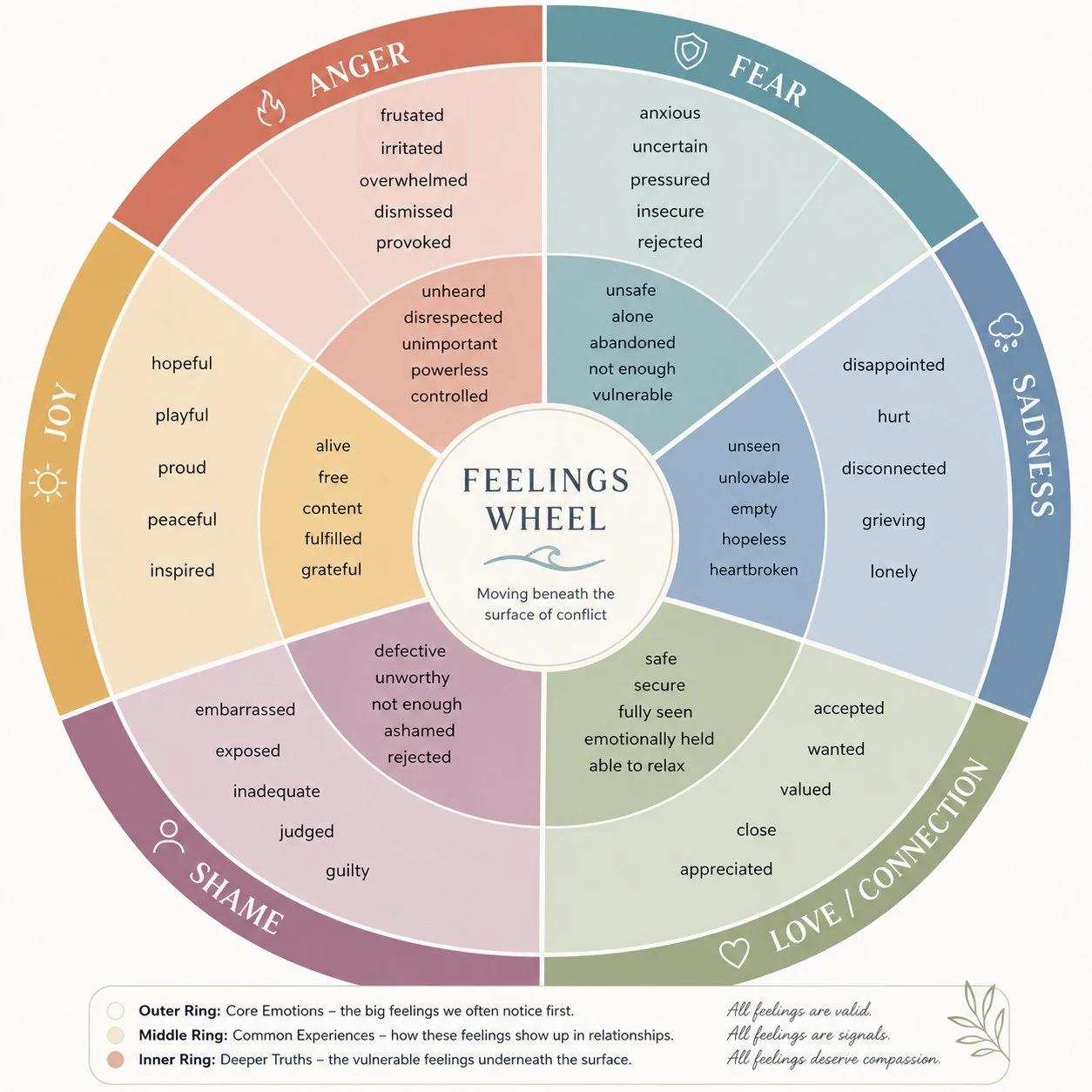
Learning to identify feelings is often like learning a new language. Many couples believe they are expressing emotions when they are actually expressing thoughts, interpretations, or conclusions about the other person’s behavior. This may seem like a small distinction, but it often changes the entire tone of a difficult conversation.

By the time a couple is arguing, defending themselves, shutting down, or trying to prove a point, they have usually missed several warning signs along the way.

Taking space during conflict can help, but only if couples also know how to come back together afterward.