
Relationships Are Not About Seeing Through Each Other, But Seeing Each Other Through
Your partner just showed you where they hurt. Don’t use that information against them.

Many couples come to therapy believing the goal is to solve their disagreements once and for all. If they can just communicate better, explain themselves more clearly, or finally get their partner to see things their way, the conflict will disappear.
Unfortunately, relationships do not work that way.
Dr. John Gottman’s research found that approximately 69% of relationship problems are perpetual. They tend to revolve around differences in personality, values, needs, habits, priorities, or vulnerabilities. Most couples are not struggling because they have failed to find the perfect solution. They are struggling because they have not yet found a way to deal with those differences without damaging the relationship.
When conflict shows up, it is easy to slip into a win-lose mindset. We focus on proving our point, defending our position, or convincing our partner that our perspective is the correct one. The problem is that winning an argument does not necessarily strengthen a relationship. You may win the argument and lose something far more important: trust, goodwill, emotional safety, or connection.
Healthy relationships are not built on successfully defeating your partner’s position. They are built on learning how to face life’s challenges together.
Understanding often comes before being understood.
Many people enter difficult conversations hoping to be heard. The challenge is that when both partners are focused on making their own point, neither person feels understood. When people feel listened to, defended less against, and genuinely heard, they become far more capable of listening in return— something I explore more deeply in Why “I Feel Like” Is Not Actually a Feeling. This is one reason I encourage couples to slow conversations down and focus on understanding before responding, a process I walk through in How to Come Back to the Conversation (Without It Turning into the Same Fight).
This becomes especially important when a partner shares something vulnerable:
“I’m afraid.”
“I feel alone.”
“I don’t think I’m important to you.”
“I feel like I’m failing.”
When someone shares a fear, hurt, or insecurity, they are taking a relational risk. At that moment, many people instinctively defend themselves, explain their intentions, or point out why their partner should not feel that way. Others unintentionally use the vulnerability against the person who shared it. A moment where recognizing early emotional signals, like the ones described in Most Relationship Fights Start Long Before the Argument, can make all the difference.
Your partner just showed you where they hurt. Don’t use that information against them.
Vulnerability is usually an invitation for connection, not evaluation. One of the fastest ways to damage emotional safety is criticism. Gottman identified criticism as one of the Four Horsemen because it attacks the person rather than addressing the problem. When people feel judged or defective, they naturally become defensive or withdraw.
The alternative is not agreement. The alternative is curiosity.
You do not have to agree with your partner’s perspective to understand their experience. Often, simply communicating, “I can see why that hurt,” or “That makes more sense to me now,” creates far more connection than a perfectly crafted defense.
The relationship itself needs protecting.
Being on your partner’s side does not mean abandoning your own needs, opinions, or boundaries. It means remembering that the relationship is more important than winning a particular moment. Problems become something the two of you face together rather than battles to be won against each other.
This mindset becomes especially important during the inevitable challenges every relationship faces: financial stress, parenting disagreements, illness, grief, neurodiversity, career transitions, family conflict, and the countless pressures of everyday life.
Strong relationships are not built because life becomes easy. They are built because two people repeatedly choose connection over contempt, curiosity over criticism, and partnership over power struggles.
The goal is not perfection. The goal is partnership.
The real measure of a relationship is not whether conflict exists. It is whether, when life becomes difficult, you have someone willing to stand beside you—someone who is more interested in understanding than winning and who remembers that the relationship is worth protecting.
Relationships are not about seeing through each other. They are about seeing each other through.
If you'd like a copy of my Four Horsemen guide, which explains the communication patterns most likely to damage relationships and what to do instead, you can request one when you subscribe to my newsletter through my website.
About the Author
Kathryn "Kassie" Welch is a Resident in Marriage and Family Therapy providing online therapy to couples and individuals throughout Virginia and Florida. Her work is grounded in the Gottman Method, with additional training in trauma, betrayal recovery, and neurodivergent relationships. She helps couples move beyond repeating patterns, strengthen communication, and create relationships that become a source of support rather than another source of stress.
Learn more or schedule a consultation at EngageRenewTherapy.com.
Continue Reading…

Taking space during conflict can help, but only if couples also know how to come back together afterward.
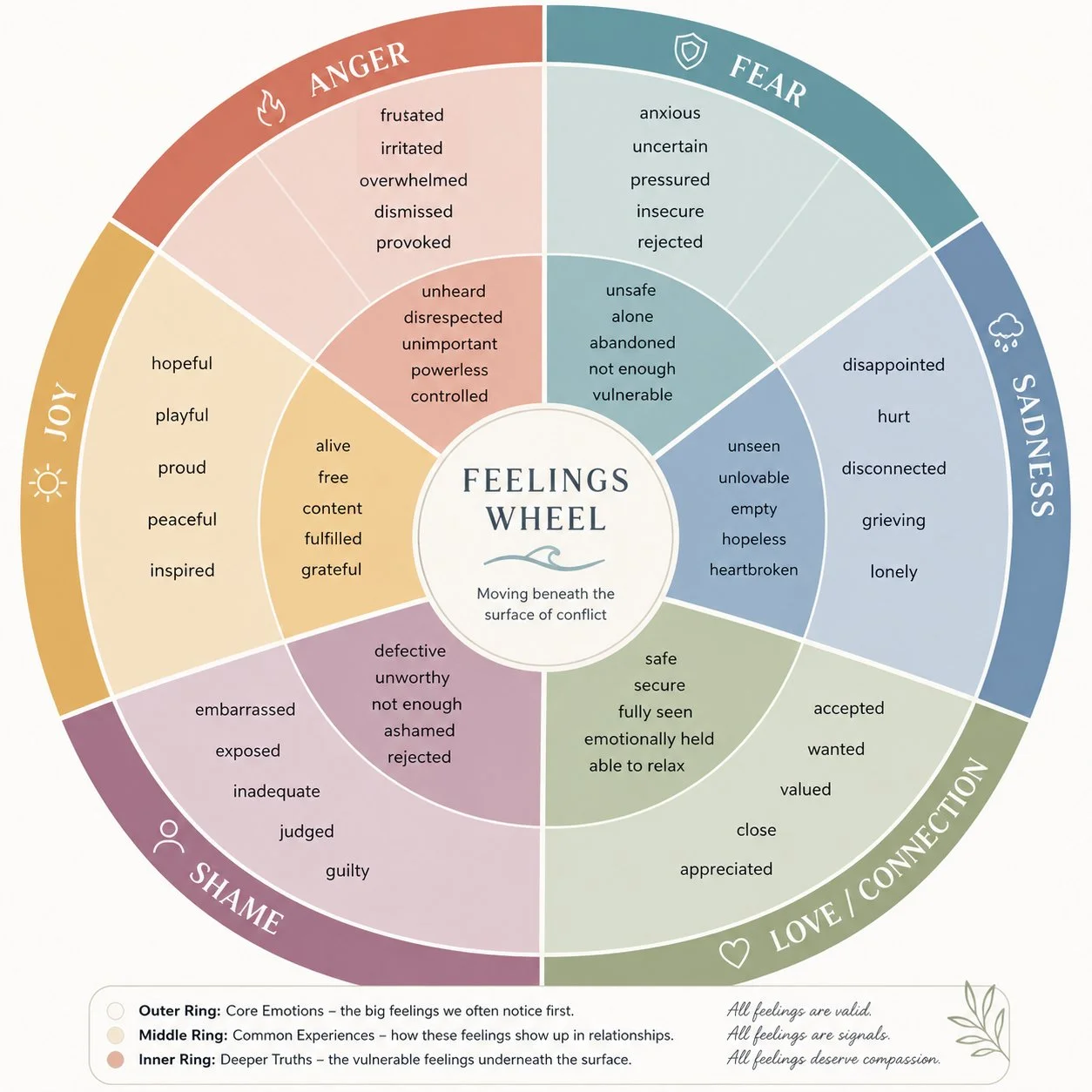
Learning to identify feelings is often like learning a new language. Many couples believe they are expressing emotions when they are actually expressing thoughts, interpretations, or conclusions about the other person’s behavior. This may seem like a small distinction, but it often changes the entire tone of a difficult conversation.

By the time a couple is arguing, defending themselves, shutting down, or trying to prove a point, they have usually missed several warning signs along the way.