
Understanding Is the Cost of Being Understood
Why feeling heard may be the beginning of real change

Most people enter difficult conversations hoping to be understood. We want our partner to understand why something hurt, why we reacted the way we did, or why something matters so much to us. The problem is that our partner often enters the same conversation wanting exactly the same thing.
That can leave two people sitting across from one another, each trying harder and harder to explain themselves while neither feels heard. We may technically be listening, but internally we are preparing our response, defending our intentions, correcting the details, or waiting for the moment when we can finally explain our side. Ironically, the harder we work to be understood, the less understanding may actually be happening.
Communication isn't only about how clearly we speak. It's also about what's happening on the other end of the string.
I have come to think there is a paradox at the center of many difficult conversations: understanding is often the cost of being understood. Someone eventually has to be willing to understand first.
Understanding Is Not Agreement
Understanding someone does not mean agreeing with them, approving of their behavior, abandoning your own perspective, or deciding that they are right. It means becoming curious enough to accurately receive their experience before asking them to receive yours.
There is an important difference between hearing the words someone says and understanding what they are trying to communicate. A partner might say, “You never listen to me.” We can immediately respond, “That’s not true. I listened to you yesterday,” and perhaps be factually correct. But we may have completely missed the message underneath the words: “I don’t feel heard by you.”
The details may matter, and there may be a time to clarify them. But challenge comes after understanding. When correction, advice, explanation, or an alternative perspective arrives too quickly, even a well-intentioned response can feel like invalidation.
When Precision Gets in the Way
This becomes especially important when couples are learning a new way to communicate. Emotional language is difficult for many people. Asking someone to move from criticism or blame into “I feel… I need… Would you please…?” may sound simple on paper, but it requires the person to slow down, identify an emotion, connect it to a need, and make a clear request while they may already be hurt, angry, or flooded.
Their first attempt may not be elegant. They may say, “I feel like you don’t care about me,” when technically that is a thought rather than a feeling. They may choose the wrong word, stumble over the request, or say something more sharply than they intended. If the immediate response is to correct the language, debate the details, or require them to say it precisely before we address the pain beneath it, they may stop trying.
Precision has value. But when we require precision before we offer connection, we can inadvertently communicate: “You have to say this correctly before I will understand you.” That is a very high bar for vulnerability.
Sometimes We Need a First Draft
One phrase I sometimes use with couples is “First Draft.” It is a way for the speaker to ask for a little latitude while they work through what they are trying to say. It can mean, “This may not come out perfectly. I am trying to tell you something important, and I am not trying to attack you.” Think of “First Draft” as a little grace period. I’m trying to reach you here. Please don’t grade my grammar while I’m trying to find the words.
It also gives the listener a job. If your partner tells you this is a first draft, try not to litigate every word or immediately defend yourself against the least generous interpretation of what they said. Listen for what they are reaching toward. You can help refine the language after you understand the message.
A first draft is not permission to be cruel. It does not excuse name-calling, threats, contempt, or intentionally hurtful behavior. It is simply recognition that vulnerable communication is a skill, and people need room to be imperfect while they are learning it.
The Relational Cost of Constant Improvement
There is another reason this matters. When every attempt is followed by another correction, refinement, suggestion, or better way to do it, improvement itself can begin to feel like rejection. Even when the intention is helpful, the cumulative message may become: “You are still not quite getting it right.”
Imagine living with someone who is continually trying to make you a better communicator, a better parent, a better housekeeper, a better planner, or a better partner. At some point, underneath all of the feedback, a much more vulnerable question may emerge: “Do you even like me?”
There is a difference between helping someone grow and relating to them as though they are a perpetual improvement project. No one wants to feel like the person they love is continually circling their mistakes with a red pen.
That question matters because people are more able to change when they don’t have to defend their worth while they’re trying to examine their behavior. If I experience feedback as evidence that I am selfish, lazy, uncaring, broken, or fundamentally not enough, I am much more likely to defend myself. Now we are no longer examining what happened. We are debating who I am.
Acceptance Is Not the Opposite of Accountability
We sometimes act as though discomfort is the engine of change: if I can make you understand how wrong this was, how badly you communicated, or exactly what you need to fix, then perhaps you will finally change. Fear, shame, punishment, and consequences can certainly influence behavior. But they can also make people more focused on protecting themselves than understanding themselves.
Love and acceptance offer something different. They create room to look honestly at behavior without making worth the question on trial. I can understand why you did something and still tell you that it hurt me. I can love you and maintain a boundary. I can accept you as a person while asking for something in our relationship to change.
Understanding does not guarantee change, and it cannot create willingness where none exists. But understanding creates the conditions in which change becomes possible. When people feel seen rather than judged, they often have more room for curiosity, accountability, learning, and choice.
Someone Has to Go First
This is the difficult part. In many painful conversations, both partners are thinking some version of “I just want you to understand me.” Both may have legitimate pain. Both may have important things to say. And both may be waiting for the other person to make the first move.
What if, for the next few minutes, your goal wasn't to be understood? What if your only job was to understand your partner well enough that they could say, “Yes. That's what I've been trying to tell you.”
Understanding first does not mean surrendering your turn. It means trusting that connection may be the shortest path back to it. Listen. Try to understand. Let your partner know what you think you heard. Ask whether you got it right. Then bring in your own experience, your questions, your disagreement, or the change you need.
Connection does not require perfect communication. It requires enough safety for two imperfect people to keep trying. Communication happens across the string. We can work hard to find exactly the right words, but connection also depends on whether someone is willing to pick up the other end and listen. Sometimes the shortest path to feeling heard begins with helping someone else feel heard first. Understanding is not the end of the work. It is often what makes the work possible.
About the Author
Kathryn "Kassie" Welch is a Resident in Marriage and Family Therapy providing online therapy to couples and individuals throughout Virginia and Florida. Her work is grounded in the Gottman Method, with additional training in trauma, betrayal recovery, and neurodivergent relationships. She helps couples move beyond repeating patterns, strengthen communication, and create relationships that become a source of support rather than another source of stress.
Learn more or schedule a consultation at EngageRenewTherapy.com.

Continue Reading…

Many couples come to therapy believing the goal is to solve their disagreements once and for all. If they can just communicate better, explain themselves more clearly, or finally get their partner to see things their way, the conflict will disappear.
Unfortunately, relationships do not work that way.
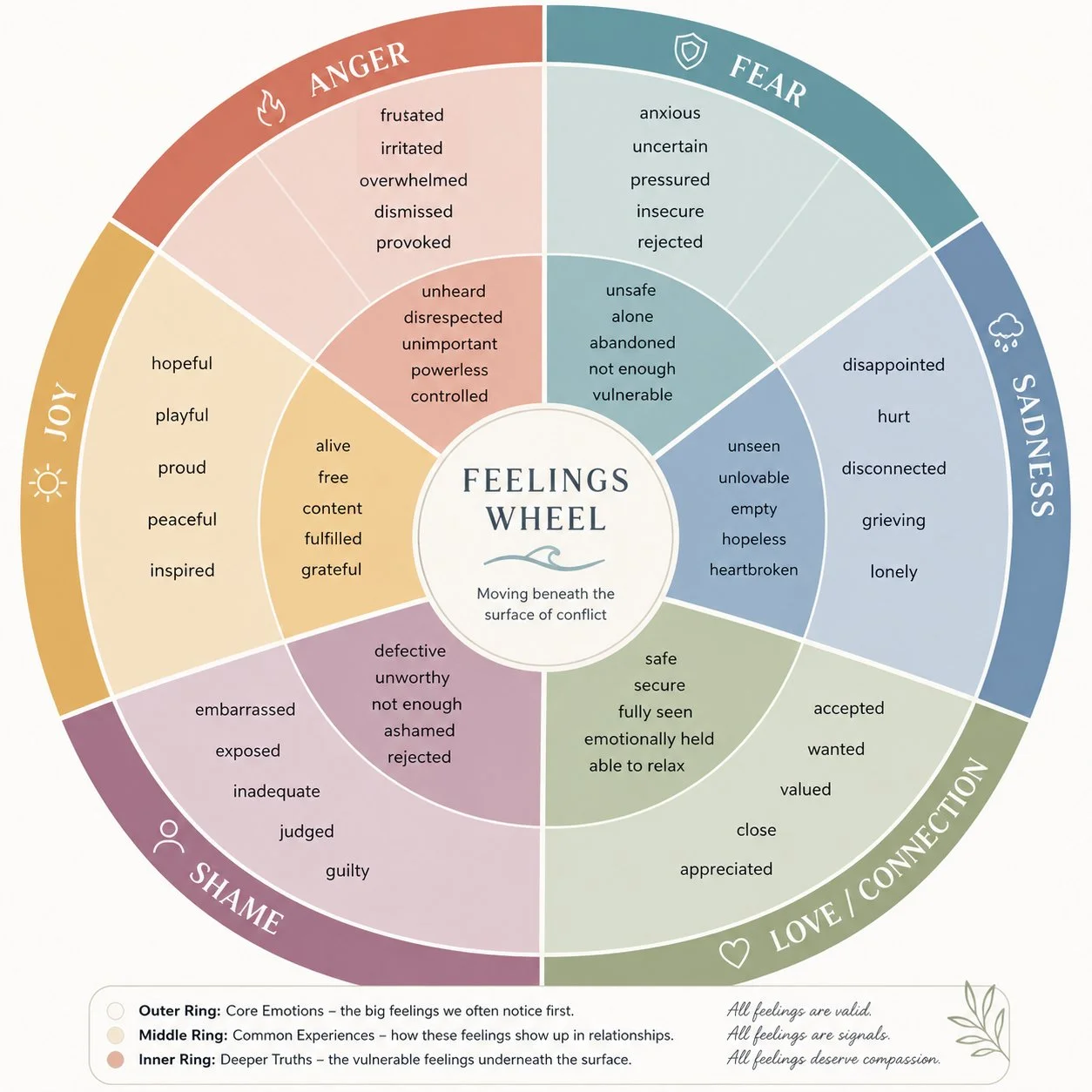
earning to identify feelings is often like learning a new language. Many couples believe they are expressing emotions when they are actually expressing thoughts, interpretations, or conclusions about the other person’s behavior. This may seem like a small distinction, but it often changes the entire tone of a difficult conversation.

Our brains are remarkably good at creating explanations when we don't know someone else's story. Unfortunately, those explanations are often wrong—not because we're bad people, but because behavior is visible while meaning isn't.
We naturally assume that what we see tells the whole story. Most of the time, it doesn't.